


INTRODUCTION
It all began with musing over what seemed to be a benign question at the time: why are all these huge ‘worship’ gatherings in Africa not resulting in missionary sending in equal droves locally and globally plus missional impact in all spheres of society with equivalent zest? In my reading of both Old and New Testament texts in the Bible, like Isaiah 6 and Acts 13, both personal and corporate atmospheres of worship resulted in a corresponding commissioning and sending. Why is that not happening spontaneously in African gatherings, on the continent with the most numbers of Christians this century? [1]
Upon later and further reflection I noticed even more yawning chasms: There is an abundance of church-going, prayer gatherings, revival meetings in addition to the worship events but to what missional end? Theologically and infrastructurally there seems to be a disconnect even between church and mission and certainly functionally between the quest for being blessed and the notion of being a blessing.
All of this led me to conclude that what we are witnessing is not a lack of ecclesial activity but a missing missional connection—between gathering and scattering, between being blessed and being a blessing, between receiving and giving, between coming and going.
That missing middle is akin to the drivetrain in an automobile—the system that connects the engine to the wheels and turns energy into motion in an automobile. Without it, the engine may roar, but the car goes nowhere.
In the same way, what the African church needs today is this missional ‘drivetrain’—a functioning connector that translates her teeming numbers and umpteen activities into real movement: the deepening, widening and furthering of the Kingdom of God on earth as it is in heaven. And urgently.
DEFINITION AND DESCRIPTION
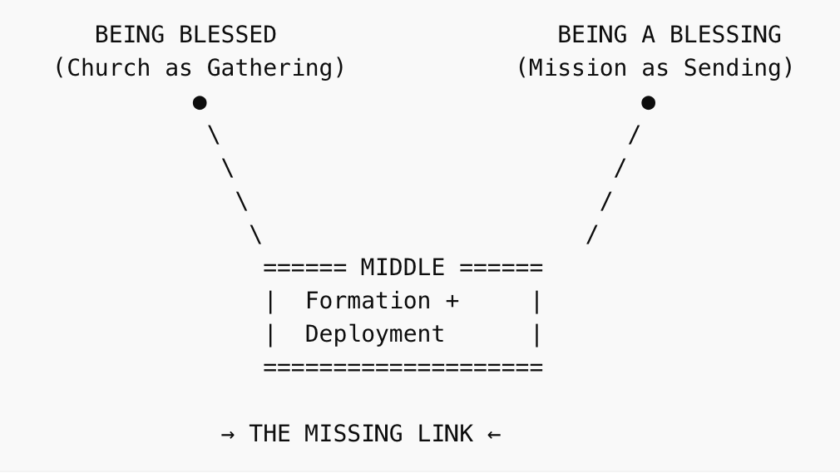
The Missing Missional Middle is the needed connector between church as gathering and mission as sending, between being blessed as a chosen people and being a blessing as a royal priesthood—the locus where believers are formed and deployed to live out God’s mission in everyday life as missional professionals and as professional missionaries. That connector or cement enables the gathered church to become a sent people on mission with God to bless the peoples, locally and globally.
The Missing Missional Middle therefore refers to the critical but underdeveloped space between the gathered life of the church and the sent life of mission, where believers are intentionally formed, equipped, and deployed to translate spiritual vitality into missional engagement. It is the absent or weak connective ecosystem that should bridge being blessed (through worship, teaching, fellowship, and revival) with being a blessing (through participation in God’s redemptive mission in the world).
In many contemporary contexts—particularly within the rapidly growing Christian landscape of Africa—this middle is marked by a structural and theological gap: churches excel at convening believers and missionaries focus on frontier engagement, yet there is insufficient formation of ordinary Christians into missional practitioners within their everyday vocations and social locations. The result is a discontinuity between ecclesial activity and missional impact, where spiritual intensity does not consistently translate into societal transformation or movemental disciple-making.

The Missing Link
So two strongly-desired ends but the bridge (middle) is what makes movement possible. Without the middle, flow stops. Blessing becomes a cul-de-sac. The missing missional middle, therefore, is not merely a programmatic deficiency but a systemic absence of mindsets, pathways, frameworks, and cultures that integrate mission with blessing, discipleship, prayer, revival and worship. It is the neglected domain where identity (“blessed”), purpose (“sent”), and practice (“on mission”) should converge. Recovering this middle requires reimagining the church not only as a gathering body or a sending agency but as a formative movement that continuously equips all believers to live as everyday missionaries—bridging the gap between worship and witness, revival and responsibility, between devotion and deployment, and ultimately, between everything church and all things mission.
DISCLAIMER
This Missing Missional Middle I speak of is unrelated to Paul G. Hiebert’s seminal 1982 article, “The Flaw of the Excluded Middle,” [1] which argues that Westerners (including missionaries) often have a two-tiered worldview that “excludes” the middle level—the realm of supernatural beings and forces that directly influence daily life, such as spirits, ancestors, demons, and curses. He noted that while many non-Western cultures focus heavily on this middle, Westerners ignore it, leading to a “flaw” in their theology and mission work.
DIFFERENT ANGLE, A LEADERSHIP ANGLE
At a recent missions consultation in West Africa I beheld yet another Missing Missional Middle—not so young yet not so old leaders were effectively ignored. It seemed a bunch of older leaders (over 60) had suddenly woken up from slumber and seen the need to mentor younger leaders (under 35). While that is not bad in itself, it seemed to have left another Missing Missional Middle in its wake, this time in terms of people. Those in the 35-50 age group—we might very might call that the Missing Missionary Middle—the Lausanne Movement refers to as ”bridge leaders” and are “in an often overlooked but crucial life stage.” [2]
In light of this, the Lausanne’s Bridge Leaders Initiative is encouraging as it aims to “identify, connect, and encourage current and future Christian leaders aged 35-50, equipping them to serve both within the Movement and the global Church. As leaders who stand between emerging and senior generations, bridge leaders have a unique role in ensuring the continuity and strength of global mission.” This demographic will be key in closing missional gaps on the continent of Africa especially, beyond just warm bodies.
WHERE DO WE GO FROM HERE? THE MISSIONAL DRIVETRAIN FRAMEWORK
This article contends that the persistent disconnect between vibrant ecclesial life and measurable missional impact is not primarily due to a lack of activity, but to the absence of a functioning connector. Across many church contexts—particularly within Africa’s rapidly expanding Christian landscape—there exists a widening gap between gathering and scattering, being blessed and being a blessing, receiving and giving, coming and going. The result is a form of ecclesial vitality that generates significant spiritual energy but insufficient missional movement.
To conceptualize the antidote to this phenomenon, I propose what may be termed the Missional Drivetrain Framework. In mechanical terms, the drivetrain of an automobile is the integrated system that connects the engine to the wheels, translating generated power into actual motion. Without this system, the engine may be fully functional—even roaring with intensity—yet the vehicle remains stationary. Energy is produced, but it is not transmitted.
This analogy provides a compelling lens through which to interpret the contemporary church’s missional challenge. The engine represents the church’s gathered life—its worship, teaching, prayer, fellowship, and revival activities. In many contexts, this engine is not only present but thriving, marked by numerical growth, spiritual fervor, and programmatic abundance. However, the wheels—representing tangible missional outcomes such as disciple-making, societal transformation, and the extension of God’s kingdom into everyday life—often exhibit limited corresponding movement.
What is missing, therefore, the missing missional middle, is the drivetrain: the intentional, integrated system that connects ecclesial vitality to missional expression. This “missional drivetrain” consists of the essential paradigms, formative pathways, theological frameworks, cultural norms, church cultures and practical structures that ensure believers are not merely gathered but also formed and deployed on mission. It is the mechanism through which spiritual energy is converted into missional engagement.
Within this framework, the “Missing Missional Middle” can be understood as the absence or weakness of this drivetrain. Where it is underdeveloped or neglected, the church risks becoming a high-energy but low-mobility system—rich in activity yet limited in impact. Conversely, where a functional drivetrain is established, the church transitions into a dynamic movement in which every believer is progressively equipped to live missionally within their everyday contexts.
The implication is both diagnostic and constructive. Diagnostically, it reframes the problem: the issue is not that the church lacks passion, numbers, or programs, but that it lacks effective transmission. Constructively, it points toward the need for deliberate design—recovering and rebuilding the missional middle as a core ecclesial priority.
In this sense, the urgent task before the church is not merely to intensify the engine nor to admire the vision of movement, but to restore the missing connector that makes movement possible. Only then can the church’s teeming numbers and abundant activities translate into sustained participation in God’s mission—resulting in the deepening and widening of His kingdom on earth as it is in heaven.
The missional drivetrain forms people, places them, supports them, aligns the system around them, and continually sends them. In a subsequenet article, I delve into five core components of this missional drivetrain framework. These details, with practical examples, truly operationalize the framework and offer a solution to the Missing Missional Middle so leaders don’t just admire the model, they can build it. In the offing also is a mission and missiology convocation specially designed with the Mission Drivetrain Framework as its scafolding.
CONCLUSION
AFRICA, the most numerically Christian continent this century, grapples with the issue of blessing, church, prayer, revival, and worship. The issue is that these don’t seem to move beyond the consumerist individual to missional transformation, from being a blessed receptable to pouring out a blessing to the world. This is the Missing Missional Middle. The Missional Drivetrain Framework is the needed connector is the needed connector between church as gathering and mission as sending, between being blessed as a chosen people and being a blessing as a royal priesthood—a locus where believers are formed, equipped and deployed to live out God’s mission in everyday life as missional professionals and as professional missionaries. That Missional Drivetrain Framework enables the gathered church to become a sent people on mission with God to bless the peoples, all the peoples, locally and globally. It is not just a place; it is paradigms, pathways, frameworks, cultures and even a people, bridge leaders.
REFERENCES
[1] Perbi, Yaw and Sam Ngugi. 2022. Africa to the Rest: from mission field to mission force (again). Xulon Press.
[2] Hiebert, Paul G. “The Flaw of the Excluded Middle.” Missiology: An International Review 10, no. 1 (January 1982): 35–47.
[2] https://lausanne.org/about/blog/bridge-leaders-initiative-equipping-generations-for-lasting-global-mission