

MISSION AND MISSIONS, CALLINGS AND CATEGORIES
God’s vision is a world filled with His glory. One so filled as the waters occupy the various seas on the planet. Full. More explicitly, this glory-filled earth is one where His name is hallowed, His will is done and His kingdom has fully come on earth as it is in Heaven. God’s vision is that heaven and earth are one, filled with His glory.
To see this come to pass, He is on a single, three-stranded mission that is tri-directional: towards Himself (bringing Himself glory), towards creation (bringing all a blessing) and against evil (to re-establish His kingdom on earth). It is God who is on mission (missio Dei, in Latin) and has invited humans to participate in this mission, hopefully as a real commitment; not mere involvement.
BREAKING IT ALL DOWN
Mission is “God’s redemptive purpose in the world which all God’s people are to participate in, by their being and doing in the world, to extend the kingdom of God on earth as it is in heaven, all flowing from and in accordance with God’s own nature and will. In Latin, it is often referred to as missio Dei (the mission of God).”1
Missions refers to “the diverse activities and ways, methods, and means of God’s people to carry out mission—evangelism, discipleship, church planting, relief work, etc. Missions is mission practice. The word is written in plural form but often treated as singular hence people who are typically not in the vocational mission(s) space tend to think there is a violation of the subject-verb agreement.”2
There aren’t many missions of God or of Christians; there is only one mission of the Most High God expressed in various human vocations or callings. Think of what I call The Mission Cascade” like this; there is:
- 1 motive of mission is God’s glory
- 1 goal is making disciples (of ourselves and of others)
- 2 modes of a missioner
- 3 forces of mission
- 6 plots that map the whole lay of the land of mission
- 12 streams of mission that missioners can move into
- 42+ tributaries akin to specific towns and villages one can live and work in on mission.
THE 1 MOTIVE
“The burning passion and overriding motive for mission is that the Lord Jesus might be renowned, worshipped, obeyed, served, and glorified among all the nations.”3 That’s it. Any other motive melts and doesn’t make the cut, compared to the fiery passion for God’s penetrating glory.
THE 1 GOAL
An image bearer or God or disciple is the primary goal. Discipleship then is the primary process of all mission—making disciples of ourselves and of others; being and making disciples of Jesus Christ. This goal is primary because that fulfills the three-fold mission of God in toto: bringing Himself glory, blessing creation and vanquishing evil to establish His kingdom (or even more rightly, to restore His kingship).
As my co-author and I elucidate in Africa to the Rest, “The primary goal of mission is to make disciples of all nations. The eternal value and significance of our strategies, programs, projects, activities, and methods is the extent to which they facilitate and result in the making of disciples who acknowledge, love, worship, obey and serve the Lord Jesus.”4
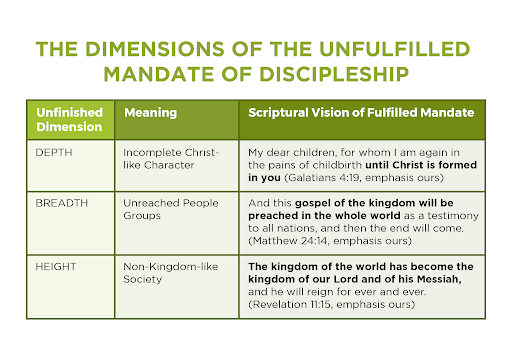
The one primary goal of discipleship is still largely unfulfilled today in these three dimensions:5
- Depth—people who come to to faith in Jesus but are still yet to be more fully conformed to his image and likeness
- Breadth—people who have yet to even hear about Jesus let alone believe in him; these are unreached people groups
- Height—systems and structures in society yet to reflect the righteousness, justice, peace, love and joy of the Kingdom of Heaven.
Mission isn’t optional. With that established as every Christian’s fundamental purpose, every Christian then has only two choices in this one matter of mission, two modes, two hats. You are either:
- Missional Professional—any profession at all from A to Z but done with the mission of God in mind (head) and compassionately executed with character as the heart through competent hands to the glory of God.
- Professional Missionary—be it in the traditional sense or in some other atypical form but either way where one takes up a vocation as a missionary and receives their upkeep from a church or mission agency.
Of course one can be a combination of these in all their lives or in certain seasons. Everything we are, have and do is for God’s purposes, His mission.
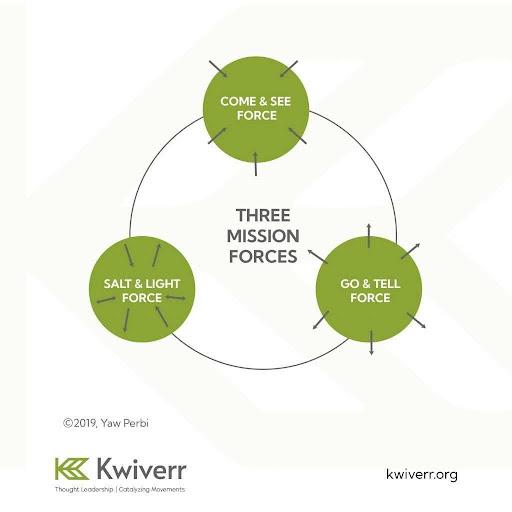
THE 3 FORCES
On mission, there are three possible directions or flows. Mission forces of the missio Dei or directions are either centripetal, centrifugal or centrifocal.6
- Centripetal (“come and see”)—mission direction from the periphery where there is no witness of God to a centre where He is worshipped,
- Centrifugal (“go and tell”)—mission direction from a Christ-worshipping centre to a periphery where He isn’t known, acknowledged or worshipped or centrifocal (“salt and light”),
- Centrifocal (“salt and light”)—here’s were we see most that although mission has a direction (it’s a vector quantity), is not fundamentally about going somewhere or doing anything but first being God’s countercultural community among the nations (to paraphrase Howard Peskett and Vinoth Ramachandra).
Certainly there can be various combinations of these at any time plus intense seasons of one or the other.
THE 6 PLOTS
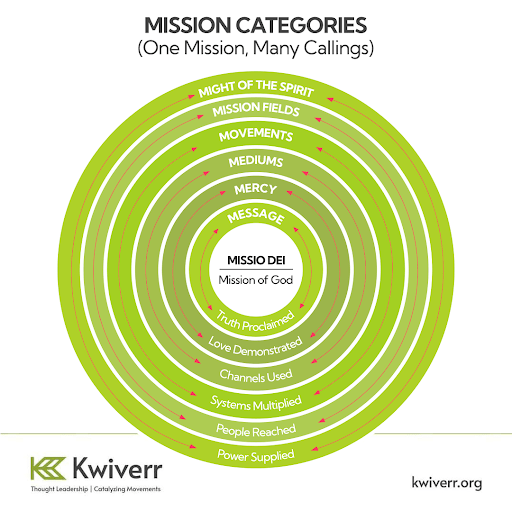
So, if there is one mission but several missions (revisit the definitions at the beginning of this article) we could map the whole territory—so-to-speak—of human engagement in the mission of God into six (6) plots.
These six (6) plots, 6M’s, would be mission in terms of:
- Message → what is proclaimed (Truth Proclaimed)
- Mercy → what is demonstrated (Love Demonstrated)
- Mediums → how it travels (Channels Used)
- Movements → how it multiplies (Systems and People Multiplied)
- Mission fields → where it goes (People Reached)
- Might of the Spirit → where power comes from (Power Supplied)
That is mission architecture; even a mission ecosystem. The Six Plots form a theological framework that is stable, non-negotiable, foundational. But people on the ground ask a different question. Most people aren’t asking: “What dimension of mission is this?” They’re asking: “Where do I fit?” “What exactly can I do?”
THE 12 STREAMS
Twelve (12) is memorable, like the tribes of Israel or Jesus’ apostles. Each stream is broad enough to include multiple callings—let’s name them tributaries—yet clear enough for someone to say: “That’s me.” These 12 streams have several tributaries people can move into according to their wiring in terms of giftings, passions, personality and experiences.
- Prayer & Spiritual Power—the engine room of mission
Here we have:
- Intercession
- Worship (Praise & Adoration)
- Spiritual warfare
- Spiritual formation / contemplative life
“Standing before God for the world.”
- Proclamation & Persuasion—the truth of the gospel made known
This includes:
- Preaching / evangelism
- Witnessing
- Apologetics
- Scripture translation
Making Christ known clearly and compellingly.
- Discipleship & Leadership Formation—people shaped into Christlikeness and further mission
The tributaries in this stream will include:
- Discipleship (being & making)
- Teaching / training
- Leadership development (which if discipleship is done well should be included)
- Mentoring (which if discipleship is done well should be included)
Forming people who live and lead like Jesus.
- Church & Community Formation—Building communities that embody the Kingdom
Here we have:
- Church planting
- Pastoral ministry
- Small groups / fellowships
- Missional communities
Creating communities where the gospel is lived and multiplied.
- Family and Next Generation—Mission through households and generational shaping
This includes:
- Family / household discipleship
- Children’s ministry
- Youth / Young adults / Campus ministry
Raising another generation who know and follow God.
- Mercy, Justice & Restoration— The compassion and righteousness of God in action
The tributaries in this stream will include:
- Mercy ministries
- Justice & advocacy
- Emergency relief
- Community development
- Rural development
- Reconciliation
- Trauma healing/Restoration
Almost every profession can be carried out in a missional manner that reflects mercy, justice and restoration, from law enforcement through engineering to medicine.
Making wrong things right and broken things whole.
- Arts, Media & Communication— Shaping imagination and culture
In this stream we have:
- Media (books, radio, social media)
- Music
- Film, storytelling, visual arts
- Content creation (particularly for social media)
Telling better stories about God and the world.
- Technology & Innovation— Designing the future with Kingdom values
This includes:
- Digital platforms
- AI / Tech ecosystems
- Innovation labs
- Strategy & foresight
Building tools and systems that shape how people live.
- Marketplace & Professions— Kingdom impact through everyday work
The tributaries in this stream are vast, and will include:
- Business as mission
- Academia as mission
- Medicine, law, engineering, sports etc.
- Workplace witness
- Missional professionals in general in all of the so-called ‘seven spheres’ (or mountains) of societal influence.
Serving God through who you are and what you do every day.
- Governance & Public Leadership—Shaping systems, policies, and nations
Although this stream could be placed under general “marketplace and professions” and is definitely one of the ‘seven spheres’ it has been pulled out for emphasis due to its multiplier effect on everything and everyone else in the comity of nations. In this stream we have:
- Government
- Policy & Advocacy
- Institutional leadership
Influencing how societies are structured and led.
- Mission Fields & Frontier Engagement— Going to people and places with least access
This includes:
- Diaspora mission
- Rural / urban / inner city
- Prison mission
- Sports communities
- Cross-cultural / frontier mission
Going to who and where Christ is not yet known—or not yet formed.
- Mobilization, Support & Sending—Fueling and coordinating the whole mission
- Mission mobilization
- Operations (admin, logistics)
- Membercare
- Generosity / Philanthropy
- Research
- Strategy & Innovation
- Board governance
Enabling others to go, stay, and be effective.
MANY MISSIONS OF MAN, ONE MISSION OF GOD
With the foregoing six (6) plots and twelve (12) streams in mind, we can pull out the following missions (mission activities), which really are the tributaries people live and work by in the missio Dei and sometimes mistakenly think they are the major streams or even the whole territory!
- Intercession mission
- Creation Stewardship Mission (Environmental/Creation Care)
- Family/Household Mission (overlooked but foundational; biblical functional unit)
- Proclaiming (preaching/evangelizing)
- Witnessing (testifying/evangelizing)
- Teaching/Training (in general, not only religious or Christian)
- Apologetics
- Scripture translation
- Language & Cultural Intelligence mission (cross-cultural communication, contextualization anthropology, linguistics (beyond translation)
- Justice & Advocacy mission
- Peace & Reconciliation mission (ethnic reconciliation, conflict mediation, peacemaking, post-conflict healing)
- Mercy ministries
- Deliverance/Freedom/Restoration Ministries (spiritual oppression, addiction recovery, trauma healing; inner healing, pastoral care)
- Worship mission
- Media mission (books, audiovisuals. audio bible, radio, TV, social media etc.)
- Digital/Tech Mission (beyond media–AI, apps, platforms, digital ecosystems shaping culture, online discipleship, virtual communities)
- Music mission (proper gospel music)
- Mission Research
- Arts & Culture mission (broader than music–Film, visual arts, storytelling, fashion, architecture; shaping imagination and worldview; culture engagement in general)
- Medical mission
- Legal mission
- Engineering mission
- Sports mission
- Prison mission
- Emergency Relief mission
- Community Development mission (eg. water, housing)
- Children mission
- Youth/Young Adult mission (eg. Campus mission)
- Inner City/Urban mission
- Rural mission
- Diaspora mission
- Business as mission
- Church Planting
- Academic mission (research, writing and teaching, including theology and missiology)
- Hospitality mission
- Leadership Development mission
- Marketplace Leadership/Governance mission (Public leadership (government, policy, civil service), Institutional influence, system shapers)
- Spiritual Formation & Contemplative mission (Retreat, spiritual direction, formation systems; Sustaining the inner life of the movement)
- Generosity/Philanthropy mission
- Mission Strategy & Innovation/Foresight Mission (Think tanks, strategy labs, future-of-mission work; designing new models, not just executing existing ones)
- Mission Operations (Administration, Logistics, Legal)
- Mission Mobilization/Mobiology (inspiration and empowerment for mission discovery, development & deployment).
CONCLUSION
God has one mission. It flows through six plots with a dozen streams branching into 42+ tributaries. And you can step into God’s mission through any one (or more) of twelve mission streams or pathways. The deeper undercurrents though are the one motive (God’s glory), one goal (discipleship), two modes (professional missionary or missional professional), and three forces (centrifocal, centrifugal, centripetal) of the missio Dei. This mission architecture, or even ecosystem, which I call The Mission Cascade, is an attempt to provide a comprehensive map of various Christian participations in the missio Dei, a taxonomy of missional callings across all of life in every nation and generation. This is theologically grounded, biblically based, practically actionable, and movement-ready. To the glory of God.
REFERENCES
- Perbi, Yaw & Sam Ngugi. 2022. Africa to the Rest: From Mission Field to Mission Force (Again). Xulon: Florida, USA, pg. xxiii.
- Ibid.
- Perbi & Ngugi. 2022. Africa to the Rest, pg. 103.
- Perbi & Ngugi. 2022. Africa to the Rest, pg. 112.
- Perbi, Yaw & Julius Coomson. 2022. Disciple Ship: Maneuvering the Master’s Mega Mandate to Make Disciples of All Nations. Kwiverr: Accra, Ghana, pgs. 5-10.
- Perbi, Yaw. Kwiverr.org