


(Kwiverr Missiology Series #4)
The Pastoral Cycle: a Pertinent Instance of ‘Missio Dare’ (Missiological Dare)
At the very start of our in-person, on-campus doctoral residence in frigid January at the Fuller Theological Seminary in Pasadena, California (USA), my Doctor of Global Leadership (DGL) cohort began to dissect the Pastoral Cycle. The Pastoral Cycle is a 45-year old method for theological reflection.
Theological reflection in ministry/mission is the process of bringing to bear on the practical decisions of ministry/mission the resources of Christian faith (Whitehead 1980 pix). In the Lausanne Movement circles, I have often heard–and from several sources–the need for Christian ministers and field missionaries to be ‘reflective practitioners.’ [1] Lausanne emphasizes that “all theological reflection must find expression in mission activity, and all mission action must be theologically grounded. The two are inseparable.” [2] The Pastoral Cycle is good reflective practice.
A Little About the Pastoral Cycle
The Pastoral Cycle is a four-stage method for theological reflection moving from Insertion Experience (seeing a situation) to Analysis/Exploration (understanding root causes), then to Reflection/Judgement (applying faith to the situation), and finally to Action/Response (acting on those insights).
Although it is called a cycle (or circle), it is often more correctly viewed as a continuous spiral rather than a closed circle. It is acclaimed to balance lived experience with faith traditions, aiming to connect belief with real-world practice, especially regarding social justice issues by using critical sociological and historical questions alongside scripture and tradition to guide prayerful action and discernment to promote transformative social change.
Back in 1980 the Center of Concern, a Catholic social justice thinktank, devised this methodological tool for promoting social analysis on critical social issues and called this tool the “pastoral circle.” This has since been disseminated globally, especially through their famous book, Social Analysis: Linking Faith and Justice, which has had over 20 editions.
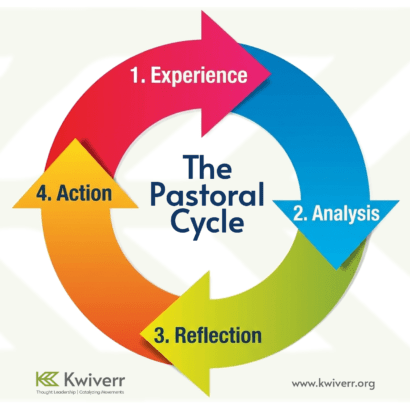
Summary of the Four Moments of the Pastoral Cycle
- Insertion Experience: Start with a real-life event, situation, or social issue from your own perspective, paying close attention to the details and feelings involved.
- Analysis/Exploration: Critically examine the situation using sociological, historical, economic, and psychological tools to uncover power structures and root causes, rather than just symptoms.
- Reflection/Judgment: Engage faith resources (Scripture, tradition, reason, prayer) to discern how Christian teaching bears on the issue and its causes, forming a moral judgment.
- Action/Response: Develop a concrete, reflective action plan based on the insights gained, moving from discernment to practical, value-driven engagement in the world.
Messiology
We shall soon circle back to this Pastoral Cycle. But first allow me to state how Missiology [3] can be a holy mess, real ‘messiology’, as one grapples simultaneously with the utterly divine and variegated human elements, especially in trying to read and cross cultures. For starters, we have global and local realities to contend with, thus the need to get ‘glocal.’ That said, however, we need not be afraid and to embrace the messiness of the process, especially contextual theologies—even the extreme of syncretism—until we come to a place of holy balance.
This lands us right at the point where there is the need for the daring to dare, and especially theologians and missiologists from the Global South dare not be caught in a blank stare.
The Dare: ‘Missio Dare’
Professors Al Tizon and Amber Smith who were facilitating the said DGL cohort comprising leaders hailing from and/or serving in Canada, Ghana, Guinea Bissau, Hong Kong, Kenya, Korea, Kyrgyzstan, Uganda and USA were challenging us to to be adventurous in our theologizing from our various corners and contexts of the world since “all theology is contextual.” Think about it: Why should someone in Germany’s theology be better than mine, for instance, just because Europe has had a firm grip on the gospel and the church over the last 1,000 years? We need to challenge where theology is allowed to think from.
This is a call to Missiological dare, which I’m daring to term ‘Missio dare’ to mimic the idea of Missio Dei, the mission of God. Of course “Missio dare” does not appear in classical Latin theology, Vatican or conciliar language, or even in mainstream academic usage so I’m neither borrowing nor colliding with an existing term.
Defining Missio Dare
Missio dare names a leadership-centred theology of mission that understands God’s sending as a summons to courageous obedience rather than territorial expansion, mere institutional maintenance or traditional occupation. Rooted in the conviction that divine purpose advances through risk, truth-telling, and costly faithfulness, missio dare frames mission as the willingness to confront systems, challenge complacency, and act decisively at the edge of uncertainty, especially from the periphery.
It locates authority not in position or preservation, but in moral clarity, spiritual depth, and the courage to lead ahead of global consensus, which often really just means Western standardization. As a prophetic framework, missio dare calls leaders—especially within African and Global South contexts—to embrace responsibility, innovation, and holy audacity as essential expressions of faithfulness to God’s redemptive intent in the world. Missio dare is not afraid of holy mess en route to authentic theological and missiological convictions that a people group can truly doubly call ‘our own’ and the Lord’s, without caving in to fear of being misunderstood, unappreciated or even challenged. As stated earlier, and is worth repeating, we need to challenge where theology is allowed to think from.
More than ever—now that the Church of the Global South is 80% of the global population of the faithful and that of the Global North is 20%, a flip of the 20-80 respectively that it used to be only 60 years ago—this is a call to Africans, Asians and Latino Americans to missio dare!
Latin-Critical Justification of Dare as Intentional Semantic Disruption
The use of the English word ‘dare’ in missio dare instead of another Latin word represents a deliberate semantic disruption rather than a grammatical error or naïve Latinity. That construct, in itself, is my own dare. Dare connotes commitment, exposure, and decisive undertaking, and although one could’ve used missio se dare (to give oneself over, to risk oneself) or audere (to dare), the formulation intentionally disrupts Latin semantics while portraying resistance to a reductive interpretation of mission as benevolent distribution or passive transmission.
Instead, it foregrounds mission and missiology as an act that places the subject at risk, requiring self-implication, resolve, and vulnerability. The semantic tension created by missio dare is therefore methodologically purposeful: it destabilizes inherited missiological categories in order to re-articulate divine sending as a summons to bold, responsible action at the threshold of uncertainty and at the risk of human insults and misunderstandings and misjudgements—including the other’s motives. In this sense, dare functions not as a descriptor of content only but as a provocation of posture, aligning the grammar of mission with the moral courage demanded of leadership in prophetic contexts, especially the Global South and Gen Z’s who will most probably never have to study Latin like our parents did and my generation had brief brushes with.
Dare as Theological Provocation: A Continental Reading
The employment of dare in missio dare is best understood not as a lapse in Latinity but as a theological provocation that mirrors the disruptive grammar characteristic of modern continental theology. As with Balthasar’s insistence that divine mission unfolds as dramatic action rather than abstract principle, dare names a posture in which the subject is drawn into risk, exposure, and costly decision. [4] The term resists the domestication of mission into program or benevolence, instead recalling the Latin reflexive se dare, where giving oneself implies vulnerability and irrevocable commitment. In this sense, dare functions analogously to Metz’s notion of dangerous memory (memoria passionis), interrupting settled categories and re-inscribing mission within the field of moral urgency and historical responsibility rather than ecclesial self-extension. [5]
Read from African ontological sensibilities, as articulated by Mbiti, dare further disrupts Western missiological abstractions by locating mission within lived agency, communal consequence, and embodied risk. [6] Mission is not something one possesses or administers but something one enters at cost to oneself and one’s social standing. The semantic tension of missio dare is therefore intentional and generative: it reorients mission from spatial movement and institutional continuity toward prophetic leadership enacted under conditions of uncertainty, where faithfulness is measured by courage, accountability, and the willingness to act ahead of guaranteed outcomes.
Methodological Note: African Theology as Hermeneutical Locus
This article does not treat African theology as a contextual application of an otherwise universal missiological framework, but as a primary hermeneutical locus from which missio dare is articulated and tested. To construe African theology merely as reception or adaptation would be to reinscribe a colonial epistemology in which conceptual generation remains elsewhere while contextual meaning is derived secondarily. By contrast, African theological traditions—shaped by communal ontology, historical disruption, moral immediacy, and embodied risk—provide a privileged interpretive standpoint for discerning mission as courageous, responsibility-bearing action. Within such contexts, leadership is not abstracted from consequence, and faithfulness is inseparable from public accountability and social cost. Missio dare therefore emerges not as a theory subsequently “applied” to African realities, but as a theological construct generated within conditions where daring action, prophetic speech, and existential commitment are already constitutive of meaning. African theology functions here not as illustration but as epistemic ground, shaping both the questions posed and the criteria by which mission is understood as participation in God’s redemptive purpose under conditions of uncertainty.
Back to FULLER
Little did our professor-facilitators of the said Doctor of Global Leadership cohort on Fuller campus know that their challenge to dare would begin right from there. Our colleague Alex from Kenya, who serves with World Vision, mentioned the need to include an important step in the Pastoral Cycle even before the Insertion Experience so that our hearts and lenses, minds and spirits are in the right place regarding issues of identity, bias etc. In other words, before observation and analysis of what’s happening out there we ought to examine what’s happening within here (within ourselves).
I quickly agreed and proposed that we graft in before the Insertion Experience, Introspection. Like the Zeroth law of Thermodynamics in Science, I proposed that instead of renumbering the four already-established parts of the Pastoral Cycle, we introduce Introspection as ‘number zero.’ [7]
My quick agreement with Alex is because I concur with author Anaïs Nin that “we don’t see things as they are, we see them as we are.” In other words, our perception of reality isn’t objective; it’s filtered through our personal experiences, worldview, beliefs, values, emotions, and biases, creating a subjective view of the world. Since our inner state shapes how we interpret external events it is expected even in qualitative research that the researcher is “fully transparent about their worldview and positionality, as they will significantly shape the research process from design and choice of methods right up to data analysis and presentation of the study’s findings.” [8].
Again, Bloom reiterates how “constructivist researchers recognize and acknowledge that their own backgrounds shape their interpretations, and they thus position themselves in the research to acknowledge their own cultural, social, and historical experiences.” [9] In other words, one needs to bring their positionality [10] to the fore. This requires much reflexivity. [11] No one comes to the task of research or theological reflection tabula rasa.
Consequently, applying this to myself, I need to put forth in the introspection step before insertion experience, for example, that I am a Black, highly educated African, Evangelical male of dual Ghanaian and Canadian citizenship and catalyzing International Student Ministries globally through Kwiverr for the Lausanne Movement and ISM Canada. Thus, a modified Pastoral Circle should have five moments, with the first one (zeroth) being introspection (see modified diagram below).
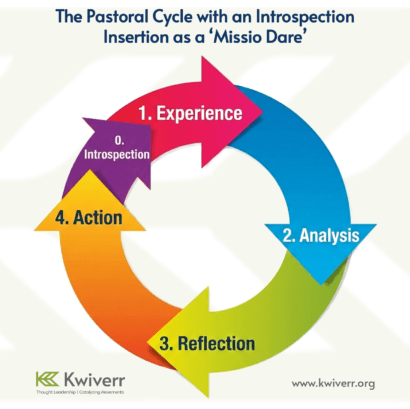
Beaten to it
In my further research on the Pastoral Circle I came across an article by on professor John Gonzalez who had beaten us to this missio dare, albeit with a centering edit rather than a proposal insertion within the cycle itself. In fact, he was thinking along the same line as my DGL class was. Hear him: “The pastoral circle itself is an attempt to promote a more objective perspective on the social issue we face. And yet the reality is that we as individuals or as a group are neither objective nor blind. Perhaps it is better understood to say that we are not value free. We come at our own social dilemmas from a particular perspective which we should honor. We should however also honor the other perspectives that confront the same social dilemma.” [12]
Consequently, what he did was to keep the four moments of the Pastoral Circle intact but to place a gospel symbol, a passionate symbol of a crucifix at the centre with double arrows that go back and forth from it. According to him, “Since this is being written for a religious community it is appropriate that we use the symbol of our faith to identify the value we affirm in promoting the pastoral circle.”
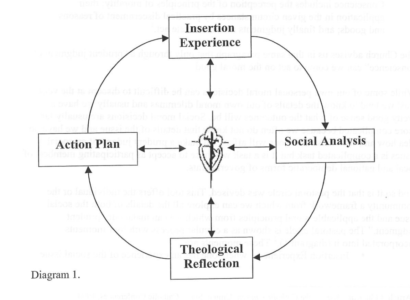
Also the double arrows to and fro the centre portray that the actions at the circumference affect the value in the centre and vice versa.
Urgency and Agency to Dare
Africans, Asians and Latin American theologians and missiologists in particular need to missiologically dare in this new world order where their populations are in the Christian majority. But this will take a lot of dare. How many times has the Lord of the harvest asked us to ‘fear not’ in Scripture? Is it not the righteous who are pictured as bold as the lion? (Proverbs 28:1) Jesus Christ commissioned his followers with all authority (divine permission) to be his witnesses (Matthew 28:16-20) as well as anointed with all power (divine enablement) to do so (Acts 1:8). We have the agency for missio dare; and for sure there is the urgency of the same today.
Conclusion
The Pastoral Cycle itself was an act of missio dare four decades ago; so are the central and peripheral insertions described in this article by Gonzalez and my Fuller DGL cohort respectively. Where the Christians are, there the theologizing must predominantly happen, with dare, thus over to the Global South.
Missiological Dare is strong territory—we’re redefining mission in the grammar of leadership courage, not ecclesial geography or christendom hegemony. Missio dare is a disruptive and provocative framework that reads as theologically serious, biblically rooted, contemporarily urgent, and relevant yet non-derivative—exactly the right balance. The latter in particular signals that it’s an original conceptual framework, not an application of inherited missiological models, but a generative reconfiguration of mission arising from a distinct theological and epistemic locus—by the Global South to the Rest.
Notes
[1] The concept of a ‘reflective practitioner’ has been extensively defined in general, most notably by Donald Schön in his seminal 1983 book, The Reflective Practitioner: How Professionals Think In Action.
[2] A deeply-held belief by both Billy Graham and John Stott that has shaped the DNA of the Lausanne Movement. Doug Birdsall, David Taylor & Loun Ling Lee in Lausanne Global Analysis, Lessons from 10 Years of Lausanne Global Analysis: Understanding our times and what we should do. November 2022
[3] History and definition of Missiology in the first of the Kwiverr Missiology series. See ‘Missiology: the Missing ‘ology’ by Yaw Perbi. Kwiverr. 2025
[4] Hans Urs von Balthasar, Theo-Drama: Theological Dramatic Theory, vol. 1, Prolegomena, trans. Graham Harrison (San Francisco: Ignatius Press, 1988), 15–19; vol. 2, Dramatis Personae: Man in God (San Francisco: Ignatius Press, 1990), 255–66. Balthasar consistently interprets divine mission (Sendung) not as an abstract principle or functional mandate but as dramatic vocation, in which the human subject is drawn into God’s action through concrete roles marked by obedience, exposure, and decision under conditions of historical risk.
[5] Johann Baptist Metz, Faith in History and Society: Toward a Practical Fundamental Theology, trans. J. Matthew Ashley (New York: Crossroad, 2007), 109–15, 183–88.
[6] John S. Mbiti, African Religions and Philosophy, 2nd ed. (Oxford: Heinemann, 1990), 102–08, 206–12.
[7] It was named the zero law because, despite being developed later than the first three laws of thermodynamics, as it provided the basis for the understanding of the concept of temperature. The concept of temperature is considered to be fundamental to the study of thermodynamics.
[8] Bloomberg, Linda Dale. 2023. Completing Your Qualitative Dissertation: A Roadmap from Beginning to End. Los Angeles: Sage Publications, pg. 76.
[9] Ibid
[10] Creswell, John W, and Cheryl N Poth. 2023. Qualitative Inquiry & Research Design: Choosing among Five Approaches. Fifth ed. Thousand Oaks, California: SAGE, pg. 4.
[11] Ibid, pg. 5.
[12] https://catholicvolunteernetwork.org/wp-content/uploads/2018/10/The-Pastoral-Circle.pdf